
The idea of naming an art corner “The Garden” likely has deep historical roots. When it comes to the garden of a great painter, it takes on even more significance. I wanted to explain the meaning of the name in the first article of the art column, which I prepared for Lits&Bits. Monet’s Garden… So, what is this garden? What kind of impact did it have on Monet and his renowned art?
Impressionism, the movement that originated in France in the second half of the 19th century, became a pivotal force in the history of art as soon as it emerged. Although it was primarily a painting movement, its influence extended to literature and music. Impressionist artists paid great attention to light play and shadows while depicting nature and everyday life. For them, capturing the fleeting moment, the “impression,” was crucial. Unlike other artists who worked in studios, they preferred to paint outdoors, aiming to directly showcase the effects of light and atmosphere on their work. Monet, a painter deeply aligned with these principles, lived in harmony with nature and focused on recreating it in his paintings. As the pioneer of Impressionism, Monet not only led this movement but also created his own artistic laboratory—his garden in Giverny. In 1883, Monet moved away from the hustle and bustle of Paris to a small town in France. There, he designed his garden according to his taste, and over the years, it became a key source of inspiration for his art

What can one gain from their garden? They might enjoy a cup of coffee, read a book, or have breakfast on a sunny Sunday. But for Monet, this garden was much more than that. It was a stage where his Impressionist vision of nature emerged in its purest, most creative form.
Monet’s process of creating this garden mirrored his passion for reflecting nature in his art. With industrialization accelerating at the end of the 19th century, rural areas were rapidly diminishing. In contrast, Monet, having settled in a small town, immersed himself in nature, far from the industrialized parts of France. When he moved there in 1883, his only possessions were a small house and vacant land. Yet, he worked tirelessly to transform the space to align with his artistic vision.
Art historian Paul Hayes Tucker, who has written extensively about Monet’s life and work, connects Monet’s creation of this garden with his Impressionist approach. Tucker argues that Monet’s goal in creating this garden was not just to depict nature as it was, but to transcend that and create his own version of nature—both in his art and in the world around him. This garden consisted of two main parts: Clos Normand and the Japanese Garden. Clos Normand, right in front of his house, was a flower garden filled with roses, tulips, chrysanthemums, and lilies. In this garden, Monet, much like in his paintings, placed colors side by side to create a living reflection of his works.
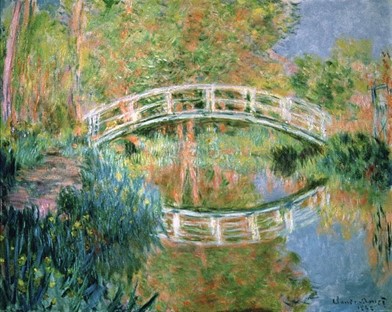
The Japanese Garden, on the other hand, was a symbol of Monet’s admiration for Eastern culture. In the late 19th century, Japanese art had a significant impact on European artists, including Monet. He was particularly drawn to Japanese prints and nature depictions. As a result, Monet had a Japanese-style bridge built in his garden, dug ponds, and planted water lilies. These water lilies would later become the subject of one of his most famous series of paintings. Monet didn’t limit himself to painting alone; he also actively engaged in gardening. Before painting a landscape, he would carefully shape it himself, deciding where to place each flower and bridge to enhance the interplay of colors and light in his artwork. Monet didn’t limit himself to painting alone; he also actively engaged in gardening. Before painting a landscape, he would carefully shape it himself, deciding where to place each flower and bridge to enhance the interplay of colors and light in his artwork.

In addition to the Water Lilies series, there are other works inspired by his garden in Giverny that help us understand how deeply the garden influenced his paintings. In his Japanese Bridge series, for example, Monet observed the shifting light at different times of day and through the changing seasons. In the earlier works, the bridge is clearly defined, but as Monet’s vision began to deteriorate in his later years, the bridge’s lines became increasingly blurred.
In The Rose Walk, a later work, Monet depicts the pathway in Clos Normand, which is covered with baker’s roses. This painting, a product of his later years, is an example of Monet’s more abstract style.
Finally, I would like to mention my favorite of his works: the Weeping Willow series. In these paintings, Monet began to focus on the weeping willows in his garden. The series coincided with World War I, and in these pieces, the Weeping Willow takes on a metaphorical meaning. Unlike his other works, these paintings reflect a darker, more melancholic atmosphere. The twisting branches of the trees and their reflections in the water create a deep emotional tone.

Today, Monet’s Giverny Garden remains a pilgrimage site for art lovers. It continues to be one of the most vivid examples of how Monet integrated nature into his art. If you ever find yourself in France, I highly recommend visiting it. If not, don’t worry—you can always visit Monet’s
Garden right here at Lits&Bits. While it may not be the original, it will still offer you plenty of artistic inspiration!
References:
- House, J. (1986). Monet: Nature into Art. Yale University Press
- Rubin, J. H. (1999). Impressionism. Phaidon Press.
Visuals:
- https://www.viator.com/Giverny-attractions/Clos-Normand/d50325-a99878
- https://www.artistsnetwork.com/art-history/monet-giverny-garden-studio/?epik=dj0yJnU9NGx0a0tlSU1rdS1KeDU0ZjFYVkxhRlAxSFRMWjd0TEwmcD0wJm49S0dWOG5ja2U0SUNrc0hmX19ObVdsQSZ0PUFBQUFBR2VnNnFv
- https://giverny.org/gardens/fcm/visitgb.htm
- https://meristemhorticulture.com/planted/claude-monet-plantsman-and-painter

