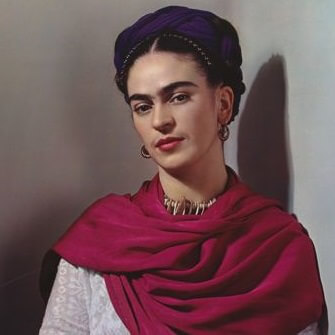
Frida Kahlo, who became a cult surrealist painter after her death, endured immense suffering throughout her life. At the age of six, she contracted polio, which left one of her legs weaker than the other. When she was seventeen, a horrific tram accident broke her spine in three places and fractured her right leg in eleven. Her collarbone and pelvis were also shattered. But the worst of all was the crushing of her pelvic bone and the iron handrail that pierced through her abdomen and exited through her vagina. Longing to become a mother, Frida was left infertile as a result of the accident.
Despite all this pain, she rarely lost her zest for life. She fought persistently to have children, and even when she was bedridden after the accident, she turned to painting, creating many of her works during this period. Throughout her life, she maintained a strong nationalist stance for her homeland, Mexico, and was one of the few women of her time to openly challenge gender norms. Out of her 159 paintings, 55 are self-portraits. Her distinctive unibrow, sometimes accompanied by a mustache, became her signature. In one painting, she even cut her hair short in a style typically worn by men of her era. She never shied away from expressing her political views and inner conflicts in her art.

She defined her life through two major tragedies: the tram accident that left her bedridden for months and her marriage to fellow painter Diego Rivera. But in her own words, “The worst of the two was Rivera.” He was nearly twice her age, repeatedly unfaithful, and incapable of even washing himself, yet he lived with Frida under the same roof as his ex-wife and children. More than husband and wife, they were colleagues, friends, and comrades in the Mexican Communist Party. Frida was a passionate nationalist and traditionalist—so much so that she changed her birth date from July 6, 1907, to July 7, 1910, to align with the start of the Mexican Revolution. Though she traveled to different countries, she always depicted herself in traditional Mexican attire in her paintings.
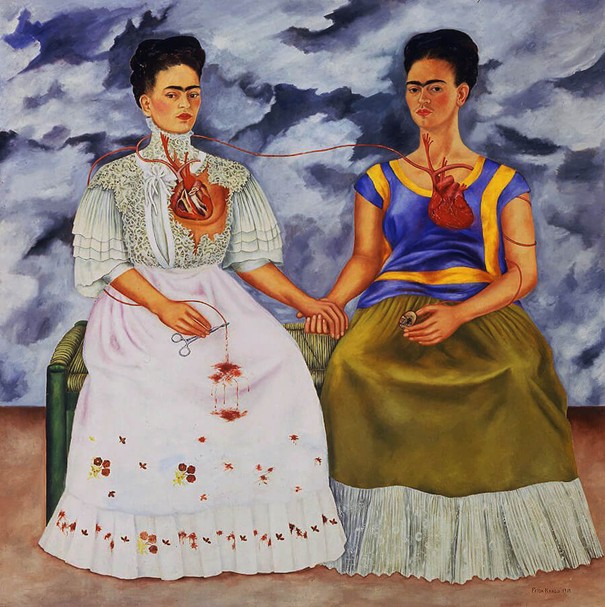
The Two Fridas is one of her most personal and intimate works. Conflicts that literature often takes pages to explore are condensed into this single painting. Frida created it during her European travels after divorcing Rivera. On one side, she wears a European-style dress; on the other, a traditional Mexican outfit. One heart is exposed and bleeding, with a severed artery in her hand, while the other remains intact, connected to a portrait of Rivera as a child. This masterpiece, born from the struggle of a woman both rejected and loved, shows that Frida had come to terms with her past and present. Yet instead of rejecting one side of herself, she keeps both Fridas connected, their hands clasped together. It conveys a universal experience of fragmentation and the necessity of accepting our memories as part of a whole.
Born to a German father and a Mexican mother, Frida was shaped by both cultures from the very beginning. Her clothing choices reflect this identity conflict. Love and heartbreak form another central theme of the painting. The Frida on the right is strong, at home, and loved; the Frida on the left is wounded and alone. The bleeding symbolizes the pain of separation. The physical and emotional suffering in the painting is so intense that, as a woman who painted her pain throughout her life, she once again depicts her heart openly—tragically and unfiltered. She never hesitates to show her scars, portraying the agony of being pulled in two directions with brutal honesty.
Frida Kahlo consistently reflected the struggles of womanhood and the pressures of patriarchy in her work. This painting is one of the clearest representations of the conflict between the identities imposed on women by society and their inner selves. Women have long been forced to conform to expectations, often struggling to preserve their own sense of self. Frida visualizes this internal battle, turning The Two Fridas into a feminist masterpiece.
Why Is It a Feminist Masterpiece?
For most of art history, female artists were overshadowed by men or forced to create works that aligned with the male gaze. Frida Kahlo, however, was a woman who found her own artistic voice and directly expressed her personal experiences through her work. The Two Fridas stands as a powerful example of women freely depicting their pain, love, and identity. By reclaiming control over female bodies, identities, and emotions through her art, she solidified this painting as one of the most significant works in feminist art history.
References:
- https://www.artchive.com/artwork/self-portrait-1940-by-frida-kahlo/#:~:text=Another%20self%2Dportrait%20from%20the,had%20betrayed%20and%20disappointed%20her
- https://www.1st-art-gallery.com/article/kahlos-famous-masterpiece-the-two-fridas/#:~:text=The%20two%20Fridas%20in%20the,chest%2C%20revealing%20a%20broken%20heart
- https://www.britannica.com/topic/The-Two-Fridas
- https://www.fridakahlo.org/the-two-fridas.jsp
- https://www.fridakahlo.org/assets/img/frida-photo.jpg
- https://artincontext.org/the-two-fridas-by-frida-kahlo/
- Arısoy, N. (2019). Frida Kahlo. Dokuz Yayınları.
- Lunday, E. (2008). Büyük Sanatçıların Gizli Hayatları. Domingo Yayınevi.