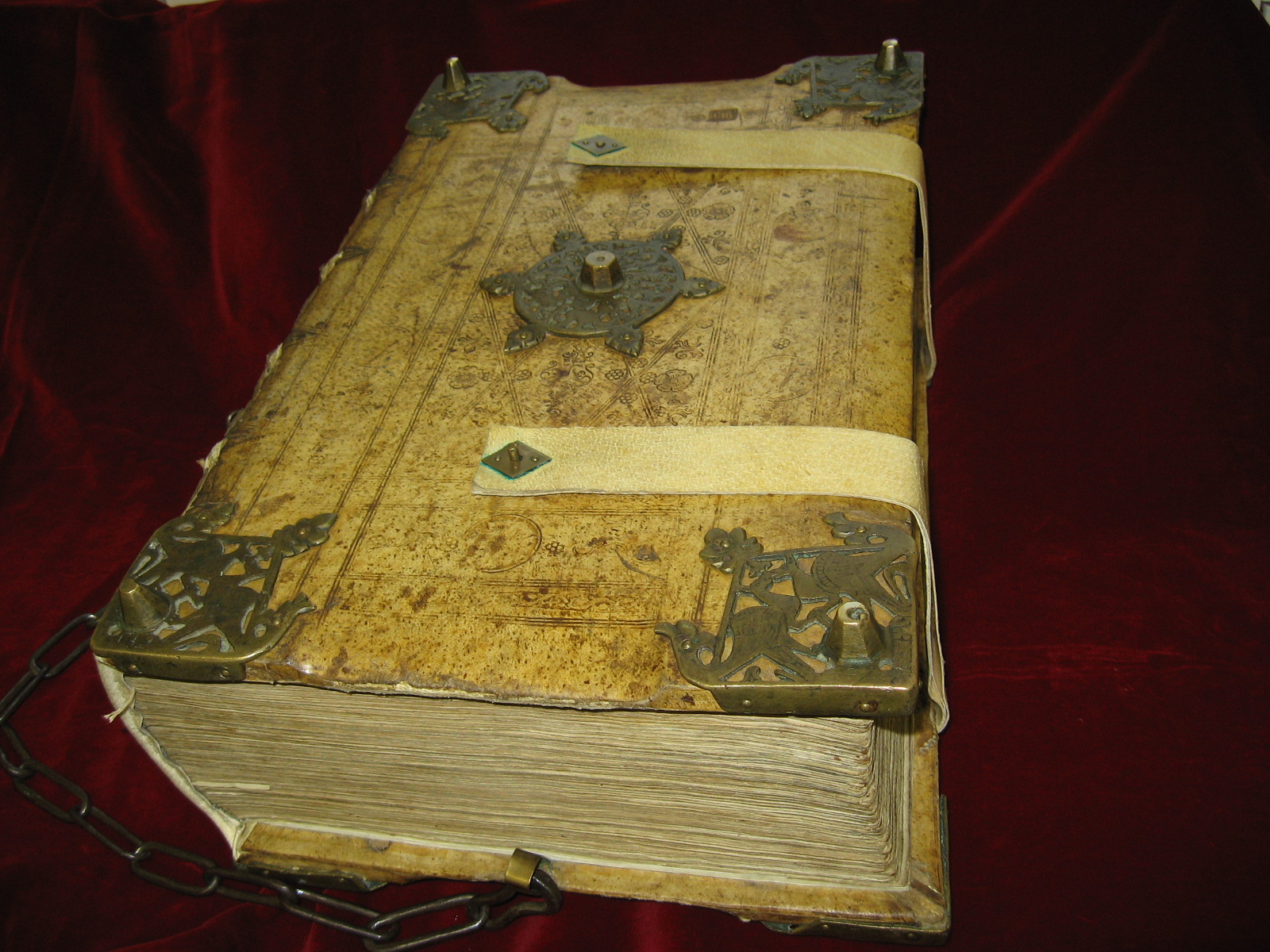
Language has always been a fundamental part of human connection, but not all languages have evolved naturally over time. Some have been carefully designed with specific goals. These are known as artificial languages. Unlike natural languages, which develop organically through social interactions, artificial languages are consciously constructed, often by a single creator. They come in many forms, from fictional languages in literature and film to auxiliary languages designed for international communication. Throughout history, people have invented languages to reduce ambiguity, simplify grammar, or serve artistic and philosophical purposes. Here, we will examine the Lingua Ignota, the first systematically constructed language, and Esperanto, the most widely used constructed language.
Lingua Ignota
Lingua Ignota, a language created by the 12th-century Benedictine Abbess, lecturer, composer, and visionary Hildegarde of Bingen, is one of history’s most enigmatic linguistic creations. Combining Latin grammar with an entirely invented vocabulary, it was primarily used in her religious visions, where she sought to communicate divine truths. Her creation of this language highlights her innovative spirit, not only in theology and music but also in linguistics.
The Lingua Ignota Alphabet
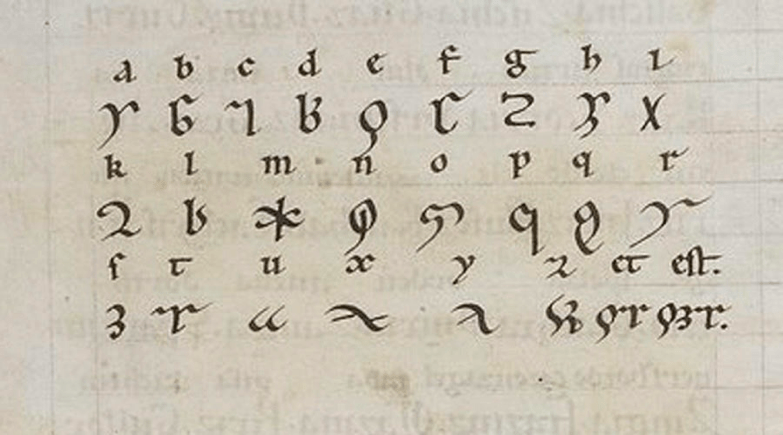
The language, found in her manuscript “Riesencodex,” was a tool for mystical expression, but it was never widely used outside of her monastic community. Interestingly, it includes a distinct alphabet and demonstrates her belief in the power of language to connect with the divine.
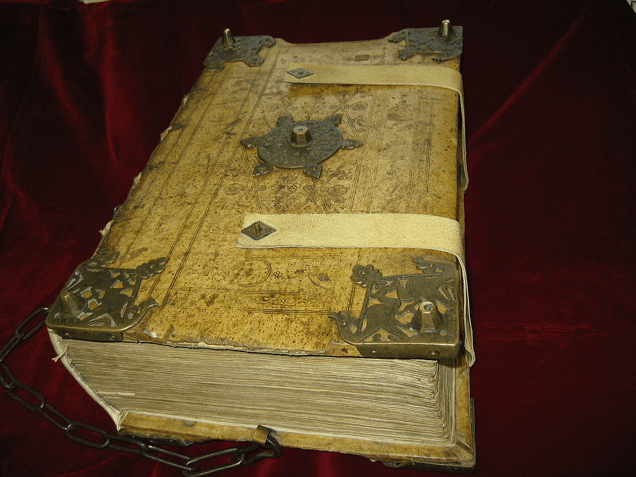
The manuscript also reveals her unique approach to communication, blending the sacred and the mysterious in a way that was ahead of its time. For centuries, scholars have tried to decipher the exact meanings behind this language, though its use appears to have been a personal and spiritual endeavor, rather than a practical one. Hildegard’s influence stretches beyond her time, making Lingua Ignota a fascinating piece of medieval linguistic history that reflects her broader creative genius.
Esperanto

Esperanto, the most widely spoken constructed language in the world, has a fascinating history marked by intrigue, political struggles, and a quest for global recognition. Over a century ago, Polish linguist Ludwik Zamenhof created Esperanto with the goal of making a simple, universal language by drawing on elements from various existing languages. Although it never achieved the status of a global lingua franca, it is estimated that hundreds of thousands of people around the world still speak Esperanto today. Zamenhof’s vision was to create a neutral language that could bridge communication gaps between people from different cultures, fostering peace and understanding. In 1887, he published a book under the pseudonym “Doktoro Esperanto”, which outlined the language’s grammar and vocabulary, featuring only 16 rules with no irregularities.
Esperanto was initially met with a warm reception, sparking the creation of clubs and the publication of literature. The first World Esperanto Congress took place in 1905 and has continued annually ever since. Despite encountering resistance from certain governments and organizations, Esperanto has endured and is still spoken by a small, dedicated community today. It has cultivated its own culture, literature, and music, and is actively used in various international events. Ultimately, Esperanto is not only a tool for communication but also stands as a symbol of hope for fostering greater understanding across diverse cultures.
References:
- https://www.oxfordbibliographies.com/display/document/obo-9780199772810/obo-9780199772810-0164.xml
- https://www.surfacelanguages.com/language/LinguaIgnota.html
- https://www.polilingua.com/blog/post/esperanto-best-known-artificial-language.htm
- https://sites.nd.edu/manuscript-studies/2015/10/01/letter-i-ardly-know-er-the-unknown-language-and-letters-of-hildegard-von-bingen/
- https://upload.wikimedia.org/wikipedia/commons/7/7c/Riesencodex.JPG
- https://www.google.com/gasearch?q=lingua%20ignota%20language&source=sh/x/gs/m2/5#vhid=607ZC0ygbngRnM&vssid=mosaic
- https://upload.wikimedia.org/wikipedia/commons/thumb/1/11/Esperanto_%28The_Universal_Language%29.djvu/page28-1484px-Esperanto_%28The_Universal_Language%29.djvu.jpg